Many websites of Slovenian companies sit online like quiet, abandoned shop windows. They have stood there for years, visitors look at outdated information and head off to a competitor that is one click away. Owners struggle to estimate how much that costs them every month.
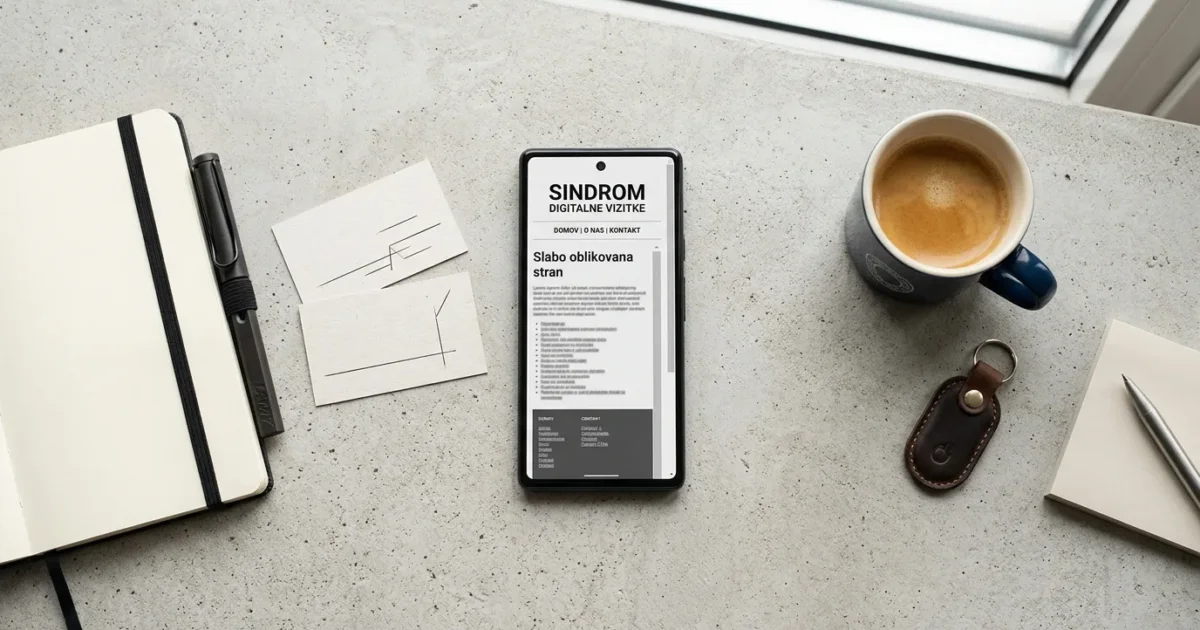
Poor search rankings or a missing presence on social media are not the main problem for small businesses. The real, rarely recognised mistake is a website that is just a passive business card, not a tool for sales and lead generation. A site like that does not communicate with visitors. It only exists.
The digital business card syndrome
The page proudly announces the year the company was founded at the top. A long, dry paragraph about family tradition, vision and mission follows. Nowhere does it explain how the company solves the customer’s specific problem and what the visitor should do next. Users do not care about company history until they know whether you can actually help them.
In the early years of the internet, simply being online was enough. Competition was thin, users browsed through subpages without complaint. A registered domain and a few pages of text no longer deliver any results. Users have grown demanding, their time is precious. If they cannot find an immediate solution to their problem on your site, they will look for it elsewhere.
How to spot this mistake in practice
A dead website is easy to recognise. The phone does not ring. No serious enquiries come through the website, the inbox fills only with spam and generic offers from abroad for dubious services. The company may still be growing, but only through personal referrals. That is not scalable in the long run and it becomes risky once the market shifts.
Menus on such sites are predictable: Home, About us, Our services, Gallery, Contact. The copy talks only about the company. Words like “we”, “our company” and “we are proud” dominate, instead of speaking to the customer and their challenges. The content is turned inward.
Contact details are often hidden, too. The phone number sits at the very bottom of a subpage, several clicks deep, and frequently is not tappable on mobile. The visitor has to invest serious effort just to find a way to get in touch with the company. These sites rarely have analytics installed, so owners do not know how many people visit and where those people leave.
The three-second test
In a fast-moving information world, one rule applies. You have three seconds to convince a visitor to stay. When someone with a leaky roof is looking for a roofer, they have no time to read the company history and look at photos of the first workshop from 1985. The search usually happens on a phone, in a hurry, often in a stressful situation.
In those three seconds the website has to communicate three things:
- what exactly the company does (a clear value proposition),
- how it will solve the visitor’s problem (concrete benefits),
- what the next step is (a visible call to action).
If those signals are missing from the first viewport on screen, the user closes the tab and clicks the next result in search. This is the bounce rate. It is a lost customer, and it also tells search engines your site is not relevant, which pushes you further down the rankings. Technical SEO optimization with a tangled structure and an unclear message cannot replace this foundation.
The cost of ignoring the problem
A bad website actively drives customers away, even though those losses are invisible at first glance. Because you do not see the people who left your site, it can feel like there is no problem and everything is fine. In reality your website behaves like a leaky bucket.
Take a simple example, a local hair salon. 300 people visit their website every month. They are looking for the price list, the location or available appointments. Because the site has no clear booking button, no visible phone number and no current price list, most give up and go to a salon that offers online booking.
If the salon converted just 2 % of those visitors into bookings, that would mean 6 new customers per month. At an average service price of 50 euros, that is 300 euros a month and 3,600 euros a year of lost revenue. That money would come in without any extra advertising spend.
For higher-priced services and in B2B, the losses are bigger. A carpenter only needs a few clients per month to fill production capacity. If an outdated site turns away three customers a month who would each pay 5,000 euros for a custom kitchen, the company loses 15,000 euros in potential revenue every month. Over a year, that is the price of new machines, additional staff or expansion into new markets.
An accounting practice illustrates how small differences in messaging change the outcome. A business owner is looking for a reliable accountant because they are unhappy with the current one. They open three websites. The first two have generic copy about “expertise and accuracy” and a contact form that asks for too much. The third site speaks to the visitor’s pain: “Feel like you are paying too much in taxes? We take over your paperwork and optimise your business.” Next to it sits a button that reads “Book a free 15-minute consultation”. It is obvious which one this person will choose. A single well-worded message wins a customer who will stay for years.
The hidden time tax
A website should work like your best salesperson. It runs 24 hours a day, with no sick days or holidays. It filters customers, qualifies enquiries and answers the most common questions.
When the site does not do this, customers call for basic information. The owner stops what they are doing to answer a question about opening hours, parking or basic prices that should already be visible online. The hidden time tax is large. If you spend 30 minutes a day answering routine questions, you lose more than 10 hours of valuable time each month. A good website automates that process and makes sure that only customers who already know what you offer and are ready to buy actually contact you.
Fixing the mistake step by step
A digital business card can be turned into an effective sales page without a costly technical rebuild. Often the right answer is strategic edits to the copy, structure and customer understanding.
Step 1: A change of perspective
Treat the website as a tool for solving customer problems, not a billboard for the company.
Old headlines tend to read like this: Novak Carpentry, tradition and quality since 1994.
A new headline foregrounds the result and the solution: Custom kitchens that use every centimetre of space and last for generations.
The first headline talks about the company. The second one explains what the visitor will get and addresses their problem (lack of space, the desire for durability). Copy that starts with “we” needs rewriting so it speaks to the customer’s needs. Use “you” more often than “we”.
Step 2: A clear call to action
People online need clear, visually highlighted instructions. If the page does not tell them what to do, they will do nothing.
Every subpage needs one main goal. A visually prominent button in a contrasting colour should communicate exactly what happens after the click.
Weak calls to action are vague and passive: Submit, More about this, Read more. Strong ones are specific and action-driven: Request a free quote, Book your appointment, Call for advice.
The button should appear several times on the same page. Once at the top, once in the middle next to the description of services, and once at the bottom, when the visitor has read all the arguments and is ready to act.
Step 3: Mobile optimisation and removing obstacles
Most local searches happen on smartphones. If the site is not adapted to small screens, you are losing more than half of your potential customers.
The path from interest to contact should be as short as possible. The phone number must not be locked inside an image. Render it as plain text with a link, so a tap opens the phone’s dialer.
Contact forms should be short. Companies sometimes ask for a home address, postcode and tax number for a simple price enquiry. Every additional field reduces the chance of conversion. The form should ask only for a name, a contact detail and a space for a short message.
Step 4: Proof, not empty promises
Claims about expertise, quality and reliability no longer work online, because everyone uses them.
Customers are convinced only by concrete, verifiable proof. Place that proof directly on the home page, not on a separate references subpage that no one visits.
For service businesses, customer reviews from Google or Facebook are credible. For tradespeople and builders, “before and after” photos work best. When the visitor sees a successfully solved problem similar to their own, trust grows substantially. Add partner logos or certificates that demonstrate expertise.
Step 5: Content search engines understand
A digital business card usually has too little text for search engines to understand what the company actually does. If you want customers to find you when they type a service plus your town, the page has to include those keywords in natural context. Create dedicated subpages for every service you offer. Instead of one Our services page that lists everything in five lines, write in-depth content for each service separately. This helps Google rank the page and helps the visitor who is searching for a specific solution. Paid online advertising can then drive traffic directly to those targeted subpages.
Step 6: Page loading speed
None of the improvements above will matter if the site loads too slowly. More than half of mobile users abandon a website that takes longer than three seconds to load. Loading speed is one of the key factors that influence both user experience and Google rankings. Oversized images, outdated code and poor hosting are the most common culprits. Always compress images and use modern formats. A fast site signals professionalism and respect for the visitor’s time, while a slow one creates frustration and breaks trust before the visitor even reads your offer.
When external help makes sense
Basic edits to headlines, contact forms and adding photos can be handled by almost anyone with modern web tools. You will reach a point, however, when you run out of time for site upkeep, writing new content and keeping up with changes in the digital world.
Once you want to scale the business and need a predictable flow of new customers, a professional digital agency is the logical choice. A good agency does not just design the site nicely, it puts user experience and conversions first. It sets up analytics so you know where your customers come from and where you lose them. It optimises the sales process, runs advertising on search engines and social media, and produces content that actually sells.
Working with an agency lets you focus on running the company and delivering the service. While you take care of the existing customers, the agency makes sure the sales pipeline is never empty. With the right partner, the website becomes an automated channel for new business opportunities.
You still have to know yourself what exactly you offer and to whom. Define your ideal customer and the solution to their specific problem, then the agency layers on its technical and strategic skills. The collaboration is not a cost, it is an investment in the sales engine.
A website needs maintenance
A website is not a printed brochure that you send to the printer once and the story is done. It is a living organism that needs care, testing and optimisation. Companies that regularly update content, add new case studies and adjust the user experience based on analytics keep their connection with the market and build authority in their industry.
Relying on a decade-old digital business card and on personal referrals alone means handing customers to a more digitally literate competitor. Online, the user is won by whoever explains fastest and most clearly how they will help, who shows proof and who makes contact easy. If you are thinking about how to turn your website from a business card into an effective sales tool, get in touch and we will work out the right approach for your market together.