“Does the optimisation of websites pay off? Why invest in something that only works in the long run?” If you have similar questions and would like greater readership, greater reach, more visits, or more purchases in your shop, you are in the right place. All of this can be achieved with higher rankings in search engines.
Website optimisation is a field that improves your results, and that literally. In the article we will check how.
Table of contents:
- Organic results are worth their weight in gold
- The essence of website optimisation
- Website optimisation and advertising
- How do search engines work?
- How to optimise a website?
- On-site optimisation
- Off-site optimisation
- The importance of content for SEO
- What is good SEO copy?
- The advantages of website optimisation
75% of people never go past the results on the 1st page in Google (HubSpot research).
Website optimisation, or ‘search engine optimisation (SEO)’, has, according to the latest data, exceeded a value of 70 billion euros annually as an industry (source: Forbes).
And it is no wonder it is so. It is one of the most key activities that every brand present online needs in order to be successful.
Whether people will find your website when they enter a search query (keyword) related to you in Google depends on website optimisation. Or will perhaps the website of your competitor appear?
A website that thrives or that stagnates, the result largely depends precisely on website optimisation.
That is why every single company needs SEO.
- Be it a local company.
- An international company.
- A small or large company.
- A huge corporation.
- Or a start-up still at the beginning of its journey.
Of course, optimisation isn’t tied only to entrepreneurship. You will also want to be high among the results if you are an artist, a blogger, or, say, a society.
Organic results are worth their weight in gold
Why? The fact is that organic results are worth their weight in gold for a brand. As much as 53% of website visits come from organic results. This means that people trust organic results on Google more than advertised results.
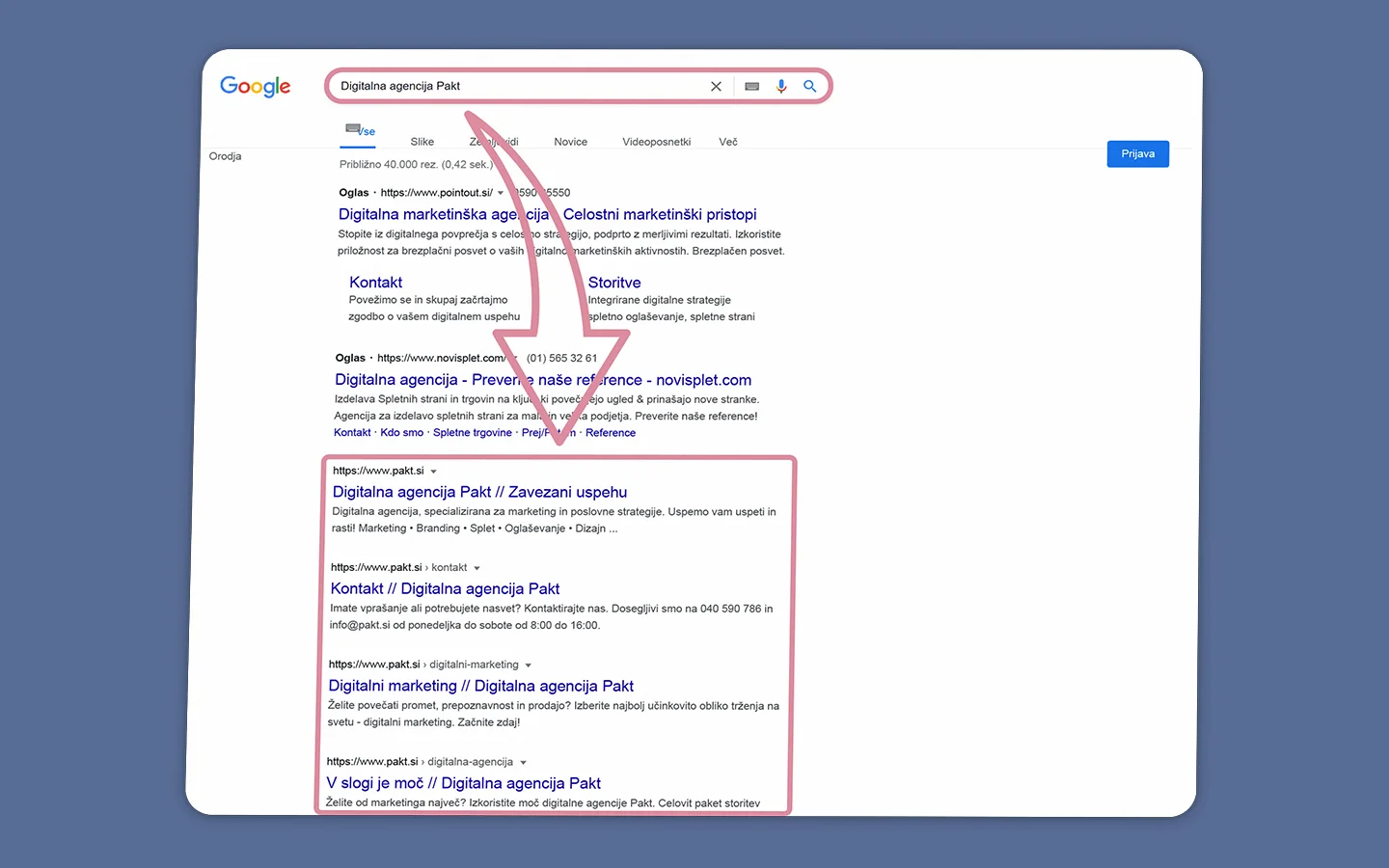
Let’s look at what organic results even are. They are all the unpaid results that Google shows us when we enter the desired keyword in the search bar. They are located below the ads or paid results (if there are none, then at the very top of the results).
Considering that 32% of people click on the first result in searches (CTR, click-through rate), being first really pays off.
The essence of website optimisation
So we come to the key reason why website optimisation is so important. Despite the fact that today many people still don’t understand SEO or perhaps don’t think it is important, it is what can significantly highlight your company online in the long run.
When we understand that 75% of people won’t even open the 2nd page of results in Google searches, while 32% will immediately click on the first result on the first page, we realise how important it is that we reach the top spots on Google.
With the help of well-implemented website optimisation, you achieve exactly that. In the long run, your website starts moving to higher places among the search results.
Website optimisation and advertising
Your website will thus start receiving higher traffic. And as a result, you will receive more enquiries and improve your performance.
“But what use is more traffic, we have that sorted,” you may say. “We regularly run Google advertising or advertising through social media.”
That is, of course, excellent, and today also highly recommended. Online advertising is, after all, an alternative to website optimisation, since it allows for really fast results.
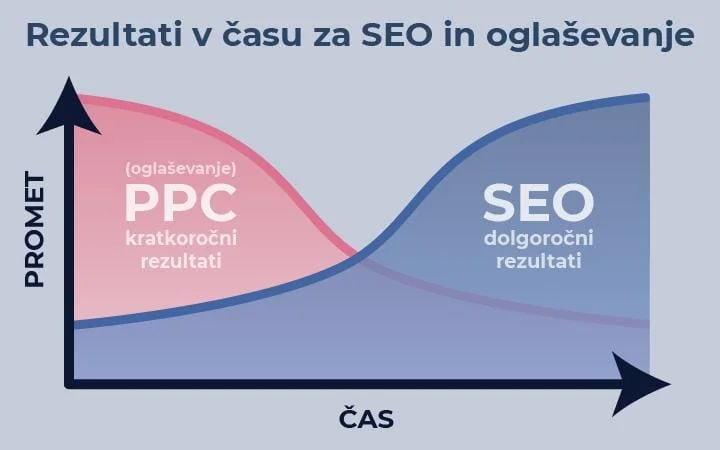
But with website optimisation, you will get the visits and traffic for free. So it is about ‘unpaid traffic’ to the website. Compared to paid advertising, which does have enormous short-term effects, well-implemented SEO brings long-term results. These can, in the long run, even exceed the effects of advertising.
While for pay-per-click ads you will always pay the same or, over time, even more and more, for a click on an organic result in the long run (apart from the initial investment in website optimisation) you will pay nothing.
SEO lowers the cost of advertising
Did you know? Good website optimisation also lowers the cost of online advertising.
The advantage of unpaid traffic is also in the credibility that organically displayed results gain. As already mentioned, internet users trust organic results more, and as a result, this also strengthens the authority and reputation of your brand.
But beware. Website optimisation is a long process. It isn’t a ‘quick fix’ and it isn’t something that would bring results immediately. As also shown by the graph above, the effects of SEO start to show through time, say after two months, with more competitive keywords perhaps only after a year. In addition, it is a never-ending process of creating and adjusting online content and acquiring links. The goal is building online authority and with it the strength of the website.
How do search engines work?
To better understand SEO, we first have to understand how search engines work.
Google (as one of the search engines) works in such a way that it ranks websites higher that, by its criteria, provide the greatest value to the reader (the one searching for a particular piece of information). And this is the only task and mission of search engines, to deliver to the user the highest-quality information for a particular search. And as quickly as possible.
To recognise which pages contain the most high-quality content, Google uses a complex algorithm. First, web ‘spiders’ visit and (occasionally) scan your website and obtain all the necessary information. Then the algorithm assesses how high-quality this page is. Based on the assessment, the page is ranked on a particular page and position among the search results.
The biggest concern of search engines is thus to make the best possible algorithm. The goal is to enable the user of the search engine to have the best possible search experience and to show them the best possible results.
How to optimise a website?
The goal of SEO is to satisfy the algorithms of search engines and in this way enable the website to be ranked higher on Google. The challenge in this is that nobody really fully understands the workings of the algorithms (the algorithms are a strictly guarded secret). But we know many laws that have to be taken into account in SEO for a good result.
We approach website optimisation thoughtfully.
First we carry out an SEO analysis and thoroughly review your website. Then we tackle the two key parts of SEO. These are on-site optimisation and off-site optimisation of websites.
On-site optimisation
The first part of SEO is on-site optimisation. In this we deal, as the English term ‘on-site’ already says, with everything that happens ‘on the website’.
This means that with advanced techniques and methods, we carry out all the necessary technical and content changes on the page.
In this we sort out, among other things:
- the domain, URL addresses of subpages, and internal links,
- the ‘title tag’ or page name,
- meta tags,
- Schema.org,
- ‘headings’ or main headings (H1, H2, H3),
- photographs (names and ALT tags),
- texts,
- videos,
- the sitemap,
- regular updating of the page,
- mobile adaptability,
- page speed,
- SSL certificate,
- adjustment of elements (UI and UX) for an excellent user experience.
The importance of keywords
To be able to carry out all of this effectively, it is key that, before starting the optimisation, we do an analysis of keywords. In this way, we determine the keywords for which we want your page to be ranked at high positions in search engines. These keywords have to be relevant to your activity. We look for general keywords (for example ‘swimsuits’), and also long-tail keywords (for example ‘women’s swimsuits’ or ‘women’s bikini swimsuits Ljubljana’). With the first, the competition is enormous, while with the latter, we will be able to achieve results faster.
The changes we make on the website will increase the credibility of the page and make the page stand out and look attractive. Both for users of the website and for search engines.
And with an excellent user experience, we will also increase the time a visitor spends on the website. This will contribute to a better assessment of the page. Google notices on which pages people stay longer and takes this into account the next time it assesses the website.
Off-site optimisation
The second part of website optimisation is connected to ‘off-site’ optimisation. So everything that happens ‘outside your website’.
This is about everything that happens elsewhere in connection with your website. Google’s algorithm rewards the websites to which importance is attributed by other pages.
For a better picture: it is about a web of links, where all websites with links vote for other websites. The more links/votes there are to your website, the higher the page will be ranked in search engines. Example: if Google notices that your article, The Best Sweet Treats in Ljubljana, has been shared, or marked with a link, by 20 other pages, Google will understand this as a ‘good article’, since 20 pages share it. The competing article only has 10 links, so yours will be ranked higher.
Regarding off-site optimisation, the following has to be sorted out:
- backlinks, these are links that other websites add to their pages and that lead to your page. Each such link adds authority and strength to your page. The strength that the page adds also depends on the strength or authority of the page that is sharing the link,
- social media, the algorithms will assess your page better if it is shared, liked, and commented on on social media,
- promotion of the page through traditional marketing, e.g. business cards, posts in magazines, advertising on billboards.
Social media isn’t, in itself, a primary factor in SEO, but it nevertheless has an impact on the algorithm. Similarly to how social media has an impact on SEO, traditional promotion influences it too. Example: if you put up a large advertising billboard on the main bypass and suddenly the traffic to your website increases, Google notices this (also from the standpoint of location). Thus it ranks the page higher, since Google notices people’s need for the ‘information’ that is on the advertising billboard. A similar effect happens with social media.
When we sort out both on-site optimisation and off-site optimisation of the page, the page will, as a result, be ranked at higher positions, because of which it will be seen and visited by an ever-increasing number of people.
The more online content you publish on your page, the better your page will be ranked in online searches.
The importance of content for SEO
As already mentioned above, for website optimisation it is very important to create high-quality and optimised content. So let’s dwell on this for a bit. When tackling on-site optimisation, we put a lot of emphasis on creating SEO content. This is about the optimisation of already existing content and the creation of always-new SEO-optimised content on your page.
Creating blogs or articles, according to data from ContentPlus (a UK-based marketing agency), provides websites with 434% more indexed pages and 97% more indexed links compared with websites that don’t have freshly published posts. Google wants to serve its users always new, current, and fresh content. The more online content you publish on your page, the better your page will be ranked in online searches.
What is good SEO copy?
Let’s look at what the text should be like for it to suit search engines:
- The article should be informative, in-depth, and should, first and foremost, bring added value to the reader. The quality of the content should take priority over the technical demands of SEO. According to Backlinko research, comprehensive and in-depth content significantly outperforms the rankings of articles without in-depth content.
- In the article, the chosen keywords should be used several times, but again, don’t overdo it with them. Quality of content should take priority.
- When entering the article on the blog, enter the page’s SEO data in it: the main title (title), description (meta description), and a tidy URL.
- The length of the article should, if possible, be longer than a thousand words. Research has shown that the average page ranked first on Google had content with 1,447 words.
- The article should have well-organised headings: H1, H2, H3. It should have only one H1 heading and structured and logically arranged subheadings.
- It should contain an introduction and a conclusion and should be enriched with lists, tables, images, infographics, and other interactive elements.
- It should contain links: external links to trusted external pages and internal links to other articles within your blog.
Want to know more? Read more about how to write a perfect SEO article.
A website that thrives or that stagnates, the result largely depends precisely on website optimisation.
The advantages of website optimisation
To finish, let’s look at everything that website optimisation brings us.
Despite the fact that the biggest challenge of SEO remains the fact that people are unaware of its power, website optimisation brings many advantages. If it is carried out in the correct (so-called white-hat) way, without attempts at quick tactics that Google can punish, you will achieve:
- An increase in website visits
- Free traffic
- Better results with online advertising
- Customer trust
- Long-lasting effects
- A great advantage over the competition
And the best result? The better your SEO results are, the less paid advertising you will need. According to some marketing research, the combination of both, SEO and Google Ads advertising, is said to greatly increase sales results. In the best case, excellent SEO results can even mean that a company can completely give up advertising.
To sum up
Website optimisation is a truly powerful marketing tool. If with its help you take care of both the technical part and the creation of high-quality content, and the consistent building of trustworthy backlinks, in time it will bring results. And with its help, you will bring new potential customers to your page, increase sales, and achieve (even) greater success.