Stories engage. Stories grab attention. With stories, we can sell endlessly more than with sales messages. Are you a company that wants to improve sales results with the power of storytelling and content marketing, but you don’t even know how to begin? Read on in this article.
Table of contents:
- So what is content marketing, and what is its goal?
- Where does the secret of content marketing lie?
- The advantages and results of content marketing
- Let’s choose the right channels and content formats
- Content suited to the stages of the buying process
- How do the best do content marketing?
- Excellent examples of content marketing
- First example of content marketing: Lego
- Second example of content marketing: Gary Vaynerchuk
- Third example of content marketing: Red Bull
- What can we learn from these top examples of content marketing?
- Does this mean we all have to create such incredible campaigns?
- The challenges of content marketing for companies
Let’s look at two scenarios. In the first one, someone who has never heard of you and your business ‘lands’ on your website. There they are met by sales offers and shouty headlines. This puts them off and the potential customer leaves your site after a few seconds.
In the second scenario, the person also comes to your website, or comes into contact with your content. There they are met by the title of a blog post that promises a solution to a problem they are currently dealing with. The potential customer clicks on the article and after 3 minutes knows more about the topic than they did before. From there they continue to the next post, download an e-book, sign up for the newsletter, and start following your posts on social media. And at every step, they trust you and your brand more.
That is the power of content marketing.
So what is content marketing, and what is its goal?
When we ask ourselves what content marketing is and how to be successful in it, we are touching on the question of what we as users of the internet still notice at all, and which things, in the endless flood of information online, we filter out unconsciously.
How, with the help of content, do you catch, and hold, people’s attention?
Storytelling has stirred the human spirit since time immemorial. Everyone likes to listen to an interesting story and lose themselves in exciting adventures. Content marketing is exactly that, the storytelling of a brand across various channels, classic and digital channels, and at all stages of the buying process. In a way that adds value and solves the problems of our readers, who, over time, become our customers.
The goal of content marketing is to build a relationship with the potential buyer. To offer them content with which they can get to know us and feel us, because of which, in time, they will become loyal to our brand. When the time comes to buy a product or choose a service, the buyer will, from a pool of providers, automatically pick us.
Why? In the process of getting to know our brand through useful or fun content, they got the feeling that we care. The feeling that someone cares is what all people need and what, deep inside, they want.
Where does the secret of content marketing lie?
Did you know that as many as 84% of people expect that brands will create their own content?
Content marketing is therefore an approach to marketing in which we focus on the constant and regular creation of useful and quality content on various digital channels. Instead of the sales content of traditional marketing, we create truly useful and helpful content with which we solve our customers’ problems.
First and foremost, it’s important that we write for our customers, not for ourselves. If content marketing activities are well set up, the consumer doesn’t have the feeling that we are trying to sell them something. Instead they read our content to inform themselves, gain new information, have fun, or follow what is happening regarding particular topics.
The secret of content marketing therefore isn’t really a secret. With it we have to, simply, to as great an extent as possible, add value. The more value we bring to users, the better the results of content marketing will be.
The advantages and results of content marketing
Let’s look at what the advantages are for a brand when it manages to achieve this.
The three main results and benefits of a successfully carried out content marketing strategy are:
- Improved sales
- Reduced costs
- Higher quality customers, who become loyal customers
Results that we surely all want. How, though, do we achieve them?
Let’s choose the right channels and content formats
Whatever marketing tactics we take, it’s important that content marketing is present in each and every marketing process that we carry out. Among others these are:
- Social media management
- E-mail marketing
- Websites and blogs
- PR or public relations
- Online advertising
- Sales promotion
Think too about the content formats that best suit your target audience. Here there really are no limits, since every way of communicating with (potential) customers can create added value and tell a story.
So with content marketing there is no need to limit ourselves only to creating classic content, as we will clearly show below.
Content formats we can use effectively are blog posts, social media posts, e-mail messages, videos, infographics, webinars, e-books, podcasts, and even books, magazines, or events.
Which marketing channel and content format we choose depends above all on our ideal customer. What will engage their attention? Where do their concerns and needs lie, and what do they want?
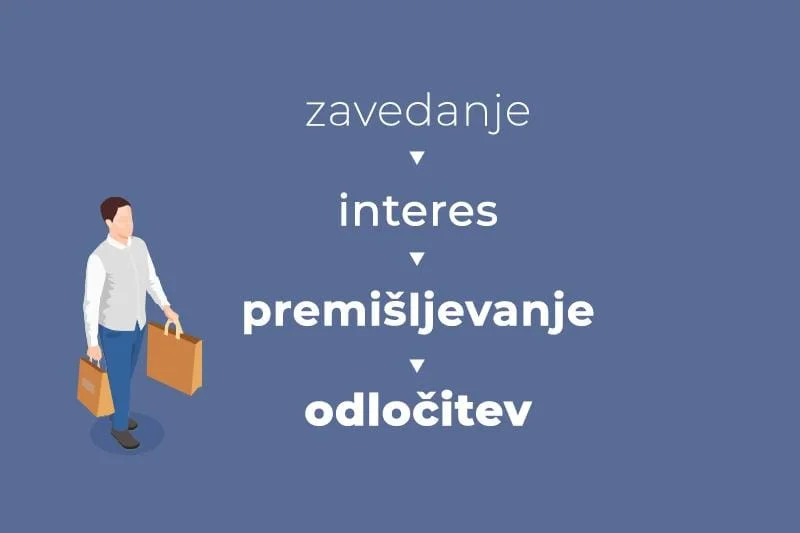
Content suited to the stages of the buying process
It’s also important that, with the chosen channels and content formats, we address people in different stages of the buying process.
- Awareness stage
- Interest stage
- Consideration stage
- Decision stage
From the first to the last stage of the buying process, the user reads and looks for content adapted to their needs. In the first stage, for example, they don’t yet know what they will choose and from whom they will buy. Here we successfully address them with articles that inform about general topics, with news, infographics, reviews, and similar informative materials.
In the second and third stages, the user already shows a certain interest in the service/product and the brand, so here we offer them more detailed materials. We can, for example, prepare videos with explanations of how to use particular products, know-how articles about how to solve a problem, live videos with questions and answers, and so on.
In the last stage the consumer is already seriously thinking about a purchase. Here we just have to convince them that we are the best choice. Through useful content such as case studies, others’ experiences, comparison tables between different products, buying guides, and similar content, we will give them added value and convince them to buy.
How do the best do content marketing?
Let’s look at a somewhat broader picture of content marketing. Content marketing isn’t necessarily only writing blog posts and other content, although that is its foundation.
Let’s look at a few examples of world-famous companies that are excellent in content marketing. These can serve as inspiration, since they use bold ideas and campaigns, because of which people follow them on their own and gladly buy and use everything from them they have on offer.
.embed-container { position: relative; padding-bottom: 56.25%; height: 0; overflow: hidden; max-width: 100%; } .embed-container iframe, .embed-container object, .embed-container embed { position: absolute; top: 0; left: 0; width: 100%; height: 100%; }
With a pinch of boldness and imagination, opportunities for unique content marketing lie at every step. Content marketing can be much more than just creating quality content.
Excellent examples of content marketing
First example of content marketing: Lego
Let’s look at how the toy giant Lego approaches this. Their target audience is, of course, children who play with Lego bricks. Their strategy is not boring creation of ads about Lego bricks. Instead, they create a complete experience of living the Lego ‘world’, adapted to all stages of the buying process of their customers.
How do they do it? Already in 1987 they launched the magazine ‘Brick Kicks’, which today comes out as the magazine ‘LEGO Club’. It is adapted for children from 5 to 9 years old and, with LEGO comics, posters, and games, it engages and charms its ideal target audience. The children get excited about Lego heroes and their stories, and buying Lego bricks is the logical next step.
Lego is exceptionally strong in content marketing. Among other things, they have a YouTube channel on which, for every new product, they release videos in the form of mini-series, which children love. Unique are their LEGOLAND theme parks all over the world, and many other ways of engaging the audience through storytelling on different channels and through different content formats.
A video example of the Lego film:
.embed-container { position: relative; padding-bottom: 56.25%; height: 0; overflow: hidden; max-width: 100%; } .embed-container iframe, .embed-container object, .embed-container embed { position: absolute; top: 0; left: 0; width: 100%; height: 100%; }
Second example of content marketing: Gary Vaynerchuk
Creating video content is also a way of engaging the target audience used by Gary Vaynerchuk. The world-famous entrepreneur, author, speaker, and internet personality makes great use of his YouTube channel, on which he posts new video content daily. He started creating videos to promote the family wine business, and over time he started sharing motivational and educational content with huge value for his followers.
On the YouTube platform he has built a $45 million empire with 3 million followers.
An example of YouTube content from Gary Vaynerchuk:
.embed-container { position: relative; padding-bottom: 56.25%; height: 0; overflow: hidden; max-width: 100%; } .embed-container iframe, .embed-container object, .embed-container embed { position: absolute; top: 0; left: 0; width: 100%; height: 100%; }
Gary is exceptionally good at distributing content across different platforms and channels (content repurposing). For example, he turns the recording of one talk into image quotes, infographics, shorter videos, e-books, blog posts, podcasts, and other formats, and uses them on the appropriate channels (Facebook, Twitter, Instagram, LinkedIn, etc.). With this he reaches a huge number of people and successfully connects channels with each other.
Third example of content marketing: Red Bull
Another of the giants of content marketing is the energy drink provider Red Bull. Just think of their campaign ‘Red Bull gives you wings’, which absolutely everyone knows. They are focused on fascinating people. They don’t just film ads; with their activities they go a big step further. They organised and hosted, for example, a jump from space, from as much as 39,000 metres above sea level, from a helium balloon.
Red Bull doesn’t sponsor events; instead, it creates, organises, and supports new, innovative events, with which it lifts the recognition of the brand sky-high. Among others, they have created many competitions in various disciplines, as well as films, shows, and documentaries, which every true sports soul gets excited about.
What can we learn from these top examples of content marketing?
What all the mentioned examples of content marketing have in common is that they don’t push their product. Instead, they align marketing activities and content with the values of the brand and the wishes, concerns, and needs of (potential) customers.
Red Bull, for example, aligned its brand with extreme sports and action and created content that is so exciting that we can’t help but watch, share, and get excited about it.
For a better understanding of what content marketing is, let’s look at a quote from James O’Brien, journalist and writer for the Contently portal:
The main idea of content marketing is that you have to give value to get value back. Instead of an ad, create a show. Instead of a banner, create a story. The value that comes back is that people start to associate good things, and to come back and engage, with the brand.
Does this mean that an ad too can be content marketing? That’s right. But only if it adds value to the user. The condition for calling something content marketing is therefore that it represents useful value to the reader.
Does this mean we all have to create such incredible campaigns?
Of course not. But these give us insight into everything that can be achieved if we create content with which we touch the deepest wishes, needs, emotions, and concerns of our customers.
The truth is that even the consistent creation of quality, relevant, and interesting blog posts can make a fundamental difference for your online presence.
Take, for example, the portal ‘Vse bo v redu’ (Everything will be alright) of the Triglav insurance company. It is one of the rare examples of an integrated approach to content marketing in Slovenia. They create quality content on the topic of safety in different life situations. This allows them to answer the concerns of potential customers through engaging posts. Readers who, in their blogs, get answers to questions about looking for and signing up for insurance, will surely choose them for their insurance services.
The challenges of content marketing for companies
Creating quality content marketing is a complex task. In a recent piece of research on the topic of ‘the biggest challenges of content marketing’, respondents replied that their biggest challenges in this are 1) creating quality and engaging content, 2) a lack of resources, and 3) a lack of time.
This therefore is not an easy task. Even so, content marketing remains exceptionally important for the running of companies and will become even more important in the future.
The solution for effectively carried out content marketing can therefore lie in hiring a digital agency. It carries out a market analysis for you, chooses the appropriate content formats and digital channels, prepares a digital strategy and a content publishing calendar and other activities, and also carries out the activities for you.
Imagine that your potential customers look forward to your next email. That they happily read your new posts and regularly follow your website and your profiles on social media? What is it that makes the difference between your brand wowing its customers with content, or not?
Let’s find out together.
Conclusion
The purpose of content marketing is to attract, inform, excite, and hold the attention of the ideal target audience. Content marketing achieves this with the help of creating content for various digital channels, and in some cases also with the help of creating events, unique campaigns, and integrated marketing campaigns.
What is the goal? To engage customers and gain loyal customers who keep coming back for ‘more’, for more content, more ‘brand’, and more of your products/services. The result follows naturally: increased conversions, higher revenue, and improved recognition of the brand on the market.