Marketing is constantly changing, and the information age has accelerated those changes even further and turned the entire market completely on its head. A new branch has emerged: digital marketing (the fastest-growing area of marketing and of business in general).
We’re talking about big shifts, but it’s not science fiction. It’s about understanding, constant learning, analysis, testing, and adaptation.

How to approach marketing?
Marketing isn’t a Facebook ad, a TV ad, or a billboard. It isn’t an idea, nor a campaign. Marketing is exchange for the common good. It’s about understanding the company, the product, and the needs of people. Awareness of the surroundings, society, and the market. You have to know the social sciences and direct that knowledge towards people. Only after that do we turn to various methods, tools, and media channels for carrying out marketing. That, however, is a topic for another time.
Forget the product, focus on people
Once upon a time, the entire focus of marketing was on the product. In 1950, an ad sounded something like this: ‘our product works the best’. In the 70s the way of communicating shifted to lifestyle, being popular, being cool (e.g. Levi’s or Coca-Cola). In the 90s, good marketing meant being funny, rebellious, or quirky. Yet the priority of advertising was still on the product or the brand. The intent was always based on creating demand for or a need for the product, in order to sell more products.
Today, it’s no longer about creating a need for the product, but about the result of the product (the feeling, the experience, the moment, and so on). It’s about the needs of people and meeting those needs.
Focusing on people (people-focused marketing), and not on products, is the most important part of this article, and if you understand this part, you are already quite successful in marketing today.
However, focusing on people isn’t our final goal. Modern brands operate beyond their customers. They serve their employees, the local community, the environment, the entire industry, even society as a whole. This is the highest level of marketing, which we will call community-focused.
But first we have to move from the product to the people. So if we look at what people need, we can see that the interest isn’t in the product itself, but in what they will get from the product, as a result.
Theodore Levitt, a professor at Harvard, says:
‘People don’t want to buy a drill, people need a hole.’

The hole is the only true value of the product. Value, in turn, can be improved further for better results. We can do this, for example, with an excellent experience while drilling the hole, e.g. how quickly we will drill the hole, how we will feel while doing it, how much electricity we will use, how safe the product is to use, whether the product is environmentally friendly, and so on. The brand name also adds value, so make sure that you never lose the trust of society. The same applies to a company’s communication, or even the actual purchase in a shop. It’s a network of connections that, in the end, make up the product.
The value of a product lies at every point of contact with your users, and the task of companies is to find these points and bring them into their product.
This way of thinking can change the game, even an entire industry. If we look at it from this angle, a company that makes cars isn’t in the automotive industry, but in the logistics or mobility industry.
This is the reason why Nike doesn’t see itself as a brand of sports clothing (focused on the product), but as a brand of an excellent experience during sports activities (focused on the human being). If Nike were to focus only on sports clothing, they would, of course, still be innovating and improving their product (e.g. running shoes and other gear), while with their focus on people, they are achieving incredible results in other areas and industries that aren’t considered sports-related. A company like that has a bright future.
As you may have noticed, if you define your business from people to product (and not the other way around), your market becomes broader, or your entire industry changes. With that, numerous new opportunities open up to you. Now you can fully and truly serve people’s needs.

Focusing on people (people-focused marketing).
Our work as a digital marketing agency is to define the business of our clients and their products in line with the needs of people. To stay with the example of the Nike brand, our task isn’t to sell sports gear in order to sell more products, but to help the Nike brand build an excellent experience for users while they are doing sports, and to generate revenue in this way.
How to achieve this?
Let’s look at the steps for easily generating business for clients.
- On a piece of paper, write down the product, then cross out the product.
- Now write down the result that users get from the product, and be specific.
- If there are several definitions, choose one or merge them into one.
- You will get an idea of what kind of business you are really in.
- Now you are ready to start operating at a higher level.
When you define your business, also keep the following factor in mind. The market is constantly developing and changing, so always be one step ahead. Don’t define yourselves only by the present, ask yourself what your business will look like in two, five, and ten years.
Kodak operated in the photography market. They made cameras, photographic film, and other photographic equipment. They were focused on the product. They constantly innovated and improved their products. Then came Flickr, Facebook, and Instagram. Their product was: ‘organising and sharing memories’. They were focused on people. They recognised the needs of people and met them with the help of digital technology. They offered a range of options, from organising photos and sharing them, to connecting with people through photos. The result? Kodak is history, and Instagram sells for 1 billion dollars.
Today, the value of Instagram is estimated at more than 100 billion dollars.

Kodak and the focus on the product.
How do banks think? Older companies are still completely focused on the product, which is why banks also only innovate around their product. What if bankers had built things like Kickstarter, Bitcoin, PayPal, or Apple Pay before the start-ups and others did?
Marc Giget says:
‘There is no candle maker who became a light-bulb maker, no carriage maker who became a car maker, and traditional mail did not invent email.’
Forget the idea
In the past, all of marketing was focused around one big idea. The idea was developed with the product in mind (focused on the product), with the aim of creating greater demand.
We don’t do this anymore. We don’t focus on one big idea, but on usefulness (focused on people). Today, we figure out what people’s needs are within a defined (business) area. Then we add value where people’s needs aren’t being met.

Identifying needs
People are different and have different needs. A single approach for all users doesn’t work. This means that if we truly want to meet people’s needs, the brand has to know the personal needs, ambitions, aspirations, and goals of all the profiles of its users.
We have several ways to identify people’s needs. Use them all.
Profiling your customers
A customer profile is a general description of your ideal customer. It includes their demographic data, what they like, what they dislike, their preferred media channels (e.g. Facebook, email, TV), and more. Writing profiles and then visualising your ideal customer allows you to find or adapt a product that is more suitable for users.
The technique can also be called: creating a customer avatar.
Use the following information: image, description, gender, age, average income, level of education, occupation, household description, hobbies, interests, fears, what is most important to them, how to do marketing specifically for this user profile, and preferred media channels. The more information you gather, the more complete the profile of your ideal user will be.
*If multiple user profiles use your product, profile each one separately.
*There are templates on the internet that you can use to create user profiles.
Connecting with users
Whether you are at the start of your business or your product is already firmly rooted in the system, always make use of interviews and surveys. You can ask your users in writing or in person about the product, the user experience, the price, and so on.

Design Thinking (understanding the end user).
A company’s view of its own product can be clouded, while your users (in principle) are always right. Neither employees nor acquaintances will give you full insight, so choose independent users. You will achieve even better results if those being asked don’t know which specific product on the market is being discussed.
If you really want to understand the needs of your end user, use the method called Design Thinking.
You can hear more about this topic on the Zakulisje podcast: What is design thinking?
Data
Today, data on how people behave is accessible to everyone. Use analytical tools, applications, the internet of things (physical things connected to the internet), online profiles, online content, personal questionnaires and surveys, and so on. The more information you gather, the better you will understand your users.
*always respect personal data and use it only when it is essential.
Put yourself in the customer’s shoes
Nothing can compare with the experience we gain ‘in the field’. If you want to find out the needs of mountain bikers, ride along with them or visit a shop that sells your cycling gear, and watch, observe, and analyse the needs of your customers.
‘A condition for good marketing, and consequently good business, is that we put ourselves in the shoes of our customers or users. If you operate in the area of running gear, go for a run. If you create a service, use it as a user, not as a developer.’
An excellent method for putting yourself in your customers’ shoes is: the user activity cycle (a method commonly used in marketing today).
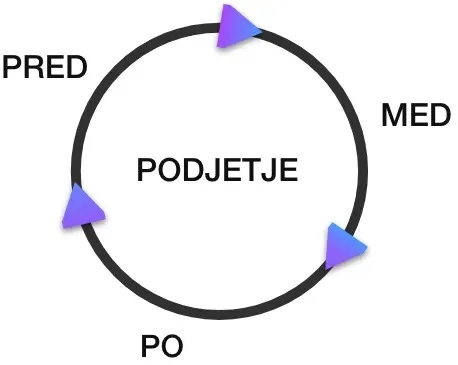
User activities, in relation to the product, are divided into three areas: -before, -during, and -after.
In the pre-stage period (-before), people decide what they will do, whether they will make the purchase, the rationale for the purchase, and which product they will buy. In the middle stage (-during), people have already bought the product and used it. In the final stage (-after), users assess and share the product.
With this approach, we get a structure of all the stages the user goes through.
Activity cycles
Companies are best aware of the middle stage, which is also the most focused on the product itself. Good marketing, however, is achieved only if we operate in balance across all three stages.
The early and final stages
This refers to the activity cycle mentioned earlier in the sense that, in the early stage, we are accessible to our users as quickly as we can be.
‘In the early stage, you want to be ahead of your competitors.’
If we want to find untapped gaps in the early stage, we look at user activities in the early stage and go back as far as we can, asking ourselves: ‘What is the user’s activity even before that?’ We repeat this several times.
For example, the activities of people in the early stage who go for a run in the morning: setting the alarm clock, sleeping, checking the weather forecast, preparing their sports gear, and so on. Now we ask ourselves: ‘What is the activity even before that?’ And we keep asking that question over and over.
This is the way, for example, NIKE ‘invented’ its Nike+ FuelBand wristband, an app for tracking running and sharing or competing with friends.
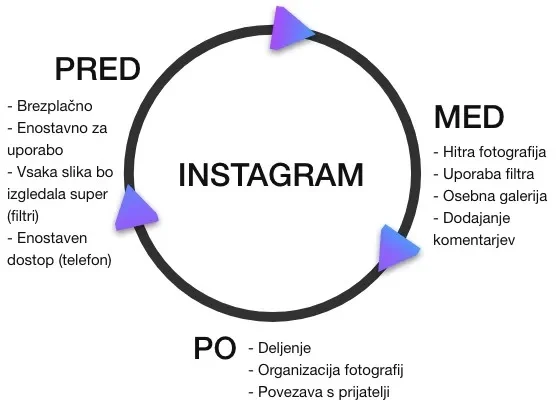
An example of using the activity cycle, Instagram.
Don’t forget, if we act very quickly in the early stage, there is still an opportunity to enter even earlier and serve people even better.
The point is to find untapped value gaps, and in this way fill the user’s needs at every possible point.
The same applies to the final stage. To find specific user-activity gaps in the final stage, the principle is the same as we used in the early (pre) stage. This time we ask ourselves: ‘What is the user’s activity after that?’ Repeat the question over and over, since there is always the possibility of staying even longer in the final stage.
Always available
Today, people are always available and responsive online. Always being active and reachable is expected. For companies, this means constant interaction through social media and their own platforms, on their website or through their app, and in general through a constant flow of content.
Instead of big campaigns, companies today communicate through several smaller (distributed) pieces of content, and much faster than they used to.
In practice, we do this by creating a platform on which we constantly post new content, update, add features, and change it. This can be an app, a website, or even a physical space.
In real time
Connections between companies and their users today happen in real time. Companies can observe what people are thinking and doing, so they can respond or adapt right away.
Real-time communication is expected from the user’s side, and if a company doesn’t respond right away, that is a value gap that needs to be filled.
In your marketing, also consider how you want to communicate with your customers. Stick to the common thread when you tell a story (storytelling).
.embed-container { position: relative; padding-bottom: 56.25%; height: 0; overflow: hidden; max-width: 100%; } .embed-container iframe, .embed-container object, .embed-container embed { position: absolute; top: 0; left: 0; width: 100%; height: 100%; }
Co-creation
Co-creation means that the company (or teams within the brand) shapes marketing together with people.
People may not like the brand or the product, but they still want to improve their lives, just as companies strive to improve people’s lives, which is why we all want to be involved and, as a result, take part.
What is important here is that companies don’t demand participation from users, but offer people the opportunity to create for themselves.
Co-creation is a very powerful form of marketing, since it is, by its very nature, focused on people (people-focused marketing).
In the real world
If a company wants to give people great experiences, it has to be part of the ‘real world’. It is only here that we, as people, experience all of our emotions. A company that is only online can never give people the (full) experience.
It’s like a band: they make great music and music videos, with which they deliver a great musical experience. But nothing can compare with a live concert.
Transparency
People want to buy good products from good companies. Trust is an important virtue. They also want to know how a company treats its employees, its impact on the environment and the local community, and whether it serves society. In fact, they don’t just want to know, they do know, because the internet creates transparency. People today see behind the ‘facade’. If it doesn’t look good, that is a value gap.
Conclusion

To get marketing started, three things are most important: a high-quality website, a thoughtful strategy, and a presence on social media.
Marketing isn’t rocket science. We just have to act in a human, logical way, and carry that across into the business world. Companies have to demonstrate trust and, with excellent communication, get closer to every individual, in the real world too. The focus of companies simply has to shift from the product (where they serve themselves) to people (focusing on the consumer), their needs, and ultimately to the community (for the higher good).