Is fast food on your list of occasional sins? Then you almost certainly know, if not by taste, then at least by name, the company KFC. Kentucky Fried Chicken is one of the largest fast-food chains in the world, specialising in fried chicken. What is the worst thing that can happen to such a company? It runs out of chicken, of course.
When you add a big dose of contrition to humour
In February 2018, KFC in the UK found itself in a bizarre situation: the chain known for fried chicken had to close more than 600 of its restaurants on the British Isles because it had run out of its basic raw material. The crisis came about because of a change of logistics partner, when the new supplier couldn’t get its transport chain in order and, as a result, couldn’t deliver chickens to the restaurants on time. Among customers, this triggered a wave of disappointment, anger, and (un)expectedly entertaining responses.
Instead of classic crisis communication, KFC opted for a different approach: a combination of humour and contrition. In a situation that could have seriously threatened their reputation, they showed that sometimes the best strategy isn’t denial or excuses, but simply admitting the mistake with a pinch of humour.
KFC went on a fire-fighting mission with a creative response that included witty print advertising, prompt social media posts, and excellent public relations.
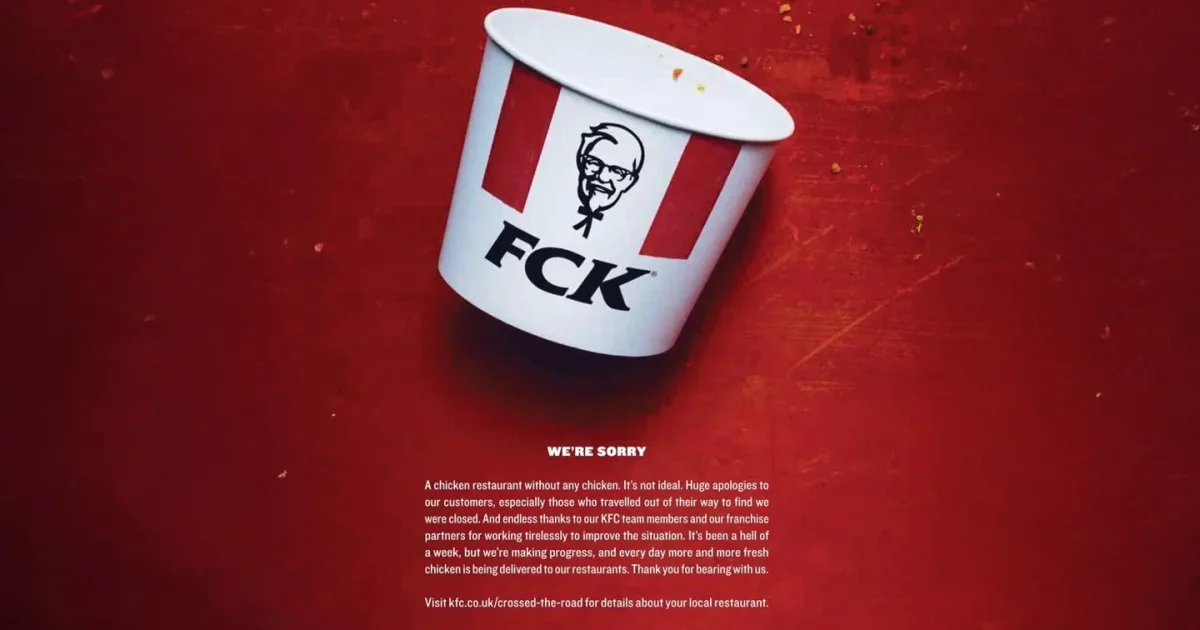
The most attention-grabbing was an ad in digital and print media that depicted an empty bucket, with the letters in the logo on it rearranged from KFC into FCK, and a note that the company sincerely apologises and that a chicken restaurant without chicken on the menu isn’t exactly the most appealing one. The financial consequences of the crisis were quite painful, but on the other hand, they turned a marketing and communication disaster into a textbook example of excellent crisis communication.
Crises are inevitable, but with a well-thought-through strategy and the tools of digital marketing, a company can keep its trust and even strengthen its brand.
Logistics in any company can be sorted out far better than at KFC, and most companies don’t usually run out of basic raw materials. But a crisis can happen to anyone, and that is when it is good to know what you can do. Crisis situations are better solved with a well-prepared strategy, or pre-defined protocols for such cases, than spontaneously.
Key steps for effective crisis management in digital marketing
1. Preparing for the unpredictable
Crises typically erupt unexpectedly, which is why it is essential to have a crisis plan ready. It should include clearly defined communication channels, responsible people, and a framework for fast action. Who will publish what, where? Who represents the company officially, and who holds the ‘strings’ in the background?
2. A fast and empathetic response
There won’t be time to hesitate. In a crisis, every minute counts. Acknowledge the problem, show empathy with customers, and offer a clear explanation of what you will do to solve it. Don’t wrap yourself in excuses and don’t pass on incomplete answers.
3. Consistent communication on all channels
A crisis knows no borders, from social media to websites and the news. It is important to make sure your message stays consistent across all platforms. It is also crucial to monitor customer responses and actively answer questions or complaints. Above all, don’t get into debates with customers about possibly justified reasons for your problems. Put yourself in their position: what got tangled up for them because of your crisis, not for you.
4. Be creative
In a crisis, brands can use a touch of humour or imagination to strengthen the connection with their audience. KFC used an imaginative campaign when they rearranged the letters into FCK, which provoked laughter and won the public’s sympathy.
5. Analysis and learning for the future
After every crisis, it is important to analyse what worked and what could have been done better. This not only reduces the risk of a repeat, but also strengthens the trust of customers and partners. The first time, a mistake may still be forgivable and even communicated in a likeable way; the second time, the chances of getting away with it will be considerably, considerably slimmer.
|
How can we help with crisis communication? Let’s talk. At the Pakt agency we understand that crisis situations are an opportunity to show how strong your brand is. Using advanced digital tools, strategies and creative approaches, we help you shape a crisis plan and respond quickly to unexpected challenges. |
Summary: highlights for successful crisis management:
– Preparation is key, have a crisis plan and clearly defined responsibilities.
– Transparency and empathy, acknowledge problems and show that you understand customers’ concerns.
– Real-time adjustment, watch customers’ responses.
– Analysis for the future, there is something to learn from every crisis.
Where to look for help? You aren’t alone in a crisis.
A crisis isn’t necessarily an event that brings only loss. It is also an opportunity for growth and for strengthening the relationship with customers. At the Pakt agency we are ready and equipped with the experience and knowledge to help you handle crisis situations with comprehensive marketing solutions.
The biggest crises often bring the biggest opportunities to show who you are and what your company’s culture is made of.