
A quality article isn’t just an excellent text; it is much more. For a perfect SEO article, the correct and standardised structuring of the text also matters, and we mustn’t forget about visual layout (for better clarity and a more dynamic read) either. Only this way do we reach an excellent user experience.

Note: when writing an article, SEO should never come first. Don’t forget that you are writing for people, not for Google’s robots. Let SEO serve only as a standard for a technically polished online article.
Time on the page
By writing an interesting, structured, and well-laid-out article, you increase reading time, or the time the visitor spends on the page, which is the first and very important SEO factor that we can influence. Google measures and follows the time of the visit on your page. A visitor who leaves the page soon after visiting it gives Google information that the article isn’t interesting enough, so it pushes the page lower among the results.
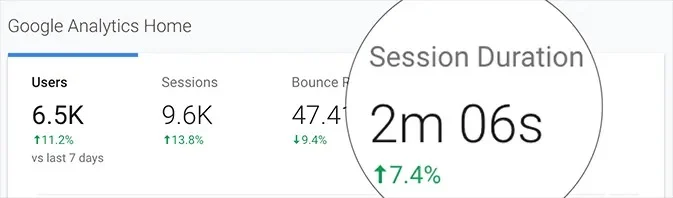
Time on the page, Google Analytics
Keywords
Keywords are words that represent the searched string of words in search engines such as Google. If we type the keyword ‘car’ into the search engine, as a search result it offers us various results connected with ‘cars’. The goal of every website owner is to be positioned highest among the results, since this brings more visits. So we could say that website optimisation (SEO) begins right with keywords.
Before you start writing the article, first do the research, find out what your main keyword is and what the other keywords are that people search through search engines.

It is important that you also include long-tail keywords in your analysis. Example: main keyword: ‘car wash’, long tail: ‘in Maribor’.
‘Long-tail keywords are an excellent alternative when you can’t compete for the main keywords.’
You can find popular long-tail keywords by searching on Google for the main keyword. Google offers you (at the bottom of the page) additional or different search strings.
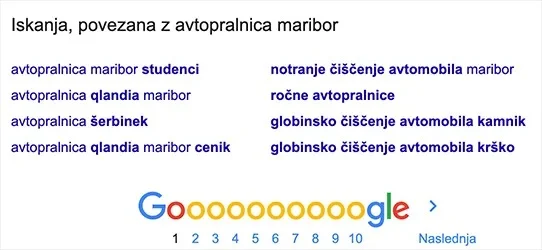
How to find keywords? Google.si
Tip: never overdo it when including keywords, since you can do more harm than good. Stick to the principle of less is more.
Page data
Main title
The main title is the first text we notice when searching on Google. The main title has to be written in a way that grabs attention and mustn’t be too long, since in that case Google cuts it off. Include the main keyword in the main title. Shape the title naturally; don’t use ‘Car, Car wash, washing — Car wash’, but ‘The best car wash in Maribor’. For greater attention you can use words such as ‘best’, ‘top 10’, ‘2019’, ‘Did you know?’, etc.
Description (meta description)
Like the main title, the description is also visible on Google, immediately under the title. The description can be at most 160 characters long, and like the main title it has to convince the user to click. So make sure it grabs attention and sums up the essence of the article. Don’t forget to add the main keyword.

Page data, Google.si
Web address (URL)
Some CMS systems, such as WordPress, Joomla, etc. allow you to set the web address (custom) too. Let the web address be short, made up only of the keyword and not of the main title.
Wrong: www.sitename.si/the-best-car-wash-in-maribor
Right: www.sitename.si/car-wash-maribor
Tip: the main title, description, and URL are also visible when you share the article on social media.
Texts
Length
Let the content of the text in the article be from 1,000 words upwards; short texts can negatively affect your SEO, so let the text be on the longer side. If you take on a topic, try to cover everything you can within that topic, since only this way will you stay above the ‘competition’. Some writers tackle so-called ‘super articles’, with 5,000 words or more, and easily reach the top spots on Google.

Heading (h1)
The article’s heading can differ from the main title, and it can also be longer, but in the heading we always keep the main keyword. It is also recommended that there be only one heading (h1) in the entire text.
Introduction to the post
It is highly recommended that we start the article with an introduction; that way we slowly lead the reader to the main topics. Let the introduction be up to 100 words long, and include the alternative and the main keyword in it.
Tip: for the introduction you can also use an adapted page description (meta description).
Heading 2 and heading 3 (h2, h3)
With subheadings we break up the article, which is very important since it gives the reader a sense of control, and they can also move more quickly to the topics that interest them. Subheadings can be made up of (previously) chosen long-tail keywords.
Lists, numbered lists, and tables
People love lists and tables, and Google loves them even more. Don’t forget to include them in the post. They are excellent ‘breakers’ of monotonous text and exceptionally effective for SEO.
Tip: for variety and for different meanings, also use bold and italic text, but don’t overdo it.
Conclusion/summary of the post
The closing summary of the post is an important part and don’t forget to add it. It has been shown that most visitors and readers first look at the end of the post, read the article’s summary, and only then return to the beginning and continue reading. If the summary isn’t there, the visitor may leave the page.
Links
External links
Since this is an online article, we have to strengthen the written text with links to good external articles (e.g. Wikipedia). With this we back up the article’s authority, since Google notices that we are connecting the article with other related articles.
Internal links
Like external links, we should connect the post with posts we have already shared on the website or blog. That way we increase the authority of already-written articles, and we don’t send readers off the website, but keep them on our own page longer. With this thinking, you will already get a lot of ideas for new articles while writing.
Photos and other content
Always add lots of content to the article, such as photos, maps, infographics, PDF documents, video clips (YouTube), and audio recordings. With additional content, the article will be more readable and more interactive.

Photos
Always include at least 3 photos in the article (depending on the other media content you will add and the article’s size). Make sure that you change the file name of the photo on your computer to the keyword, e.g. ‘car-wash-maribor.jpg’, and add the keyword to the photo’s (alt) tag too.
Conclusion
With all the listed properties of a perfect SEO article, we will satisfy every reader, and as a result Google too. It may seem to you that this is complicated and unnecessary work, but in time you will write SEO articles without thinking about SEO, since this is a pattern, structure, and standard that you have to stick to in any case. The work definitely pays off, with visible results. I wish you many excellent articles.
Need help writing online SEO articles?
The Pakt agency can help you with this; we have more than 15 years of experience with the web, websites, and search engine optimisation.
Send your enquiry through our website: Search engine optimisation